Home About Portfolio Photo Library Articles & Features
SEARCH
Jungly Fever
Veteran of some of the most significant military campaigns in recent history, Vobster's new Sea King helicopter has a fascinating story to tell. Jason Brown reveals the illustrious past of ZA299...
The story behind Vobster's
Sea King helicopter...
Inland diving sites offer a great opportunity to keep the gills moist without the ever constant threat of bad weather blowing out your dive.

Wherever you live in the UK, there's a good chance you're not too far from one of these dependable diving microcosms – whether it's Capernwray in Lancashire, NDAC near Chepstow or good old Stoney Cove in the very heart of England, there's no excuse for not getting wet regardless of what the weather gods see fit to throw at you.
Feature Details
Author:
Jason Brown
Publication Date:
March 2018
Publication:
Scuba Diver UK
Feature catagory:
Shipwrecks
Photo Gallery #1:

This feature and all images are copyright © Jason Brown and may not be republished, reproduced or copied in any form without the express written permission of the author. This feature and all images are available to licence.
Every weekend you'll find these little bastions of British diving packed with divers keen to get their fresh water diving fix. They offer a strangely eclectic mix of diving experiences – where else can you visit Lord Lucan and Shergar, explore the remains of an Elizabethan 'Gresham ship' or get completely freaked out by a deranged carnival jester peering menacingly at you through the silty gloom? Such 'attractions' are par for the course at many of the UK's popular inland sites.

Of course diving attractions don't get much cooler than something that's got an ex-military background. It's not unusual to find veterans of campaigns across the globe gracing lake beds throughout the UK – Capernwray has its Dickens-class minesweeper that saw service during WW2, Stoney has its armoured personnel carrier and NDAC boasts both an Alvis Stalwart amphibious vehicle and an Alvis Saracen troop carrier. But what we really love is something with wings – or, to be more precise – rotors! Joining the ranks of the submerged ex-military elite is Vobster Quay's latest addition – an ex-Royal Navy Westland Sea King helicopter. This new attraction joins Vobster Quay's other erstwhile military veteran, a GKN Sankey FV432 armoured personnel carrier

A Distinguished Career
The Sea King helicopter was a British licence-built version of the American Sikorsky S-61 helicopter manufactured in the UK by Westland Helicopters (now AugustaWestland) of Yeovil. Dating back to the late 1950s, the Sea King was originally developed by the US military to counter the growing threat of Soviet Submarines. Its unique hull-shaped belly and sponson-mounted floats made it the world's very first truly amphibious helicopter capable of landing and taking off on water. The UK version of the Sea King was adapted with the fitment of Rolls-Royce Gnome engines and a fully computerised flight control system.
"With Argentinian Air Force jets attacking the fleet anchored in 'Bomb Alley' San Carlos Water, ZA299 proved her worth..."
Vobster's Sea King - registration number ZA299 - is an HC4 (Mk 4) Commando variant, a medium-lift support helicopter formerly operated by the Royal Navy's Commando Helicopter Force (CHF). Affectionately known as 'The Jungly' by the Royal Marine Commandos, the HC4 served as the backbone of the Commando Helicopter Force for many years.

Falklands Veteran
Like most things ex-military, ZA299 is so much more than the sum of its parts – dig deeper and you'll discover a fascinating and distinguished history that spans over 30 years of service with the Royal Navy. ZA299 took to the air for the very first time on the 10th September 1981 under the control of Westland test pilot JC Teasdale. Delivered to RNAS Culdrose and then assigned to 846 Naval Air Squadron in November of the same year, it wouldn't be long before ZA299 saw action for the very first time when Argentina invaded the Falkland Islands in 1982.

Shipped down to the South Atlantic on board the Royal Navy's taskforce flagship HMS Hermes, ZA299 was later detached to both the SS Canberra troop transport and MV Europic Ferry in aid in the unloading of essential supplies. With Argentinian Air Force jets attacking the fleet anchored in 'Bomb Alley' San Carlos Water, ZA299 proved her worth and made a considerable contribution to the eventual liberation of the Islands.

ZA299 would later go on to see service in other campaigns across the globe. In 1993, she would travel to the former Yugoslavia as part of 'Operation Grapple' - UK defence operations in support of the UNPROFOR peacekeeping missions. She'd also see service in both Iraq and Afghanistan, providing essential support to coalition forces in both campaigns. Leaving Kandahar for the last time in June 2008, ZA299 returned to the UK from her very last tour of front-line duty. Her final assignment came in 2010 with 845 Naval Air Squadron. Finally, in 2014, the Royal Navy began the process of replacing its aging fleet of Sea Kings with the AugustaWestland AW101 Merlin HC3 helicopter.

The Long Road to Vobster
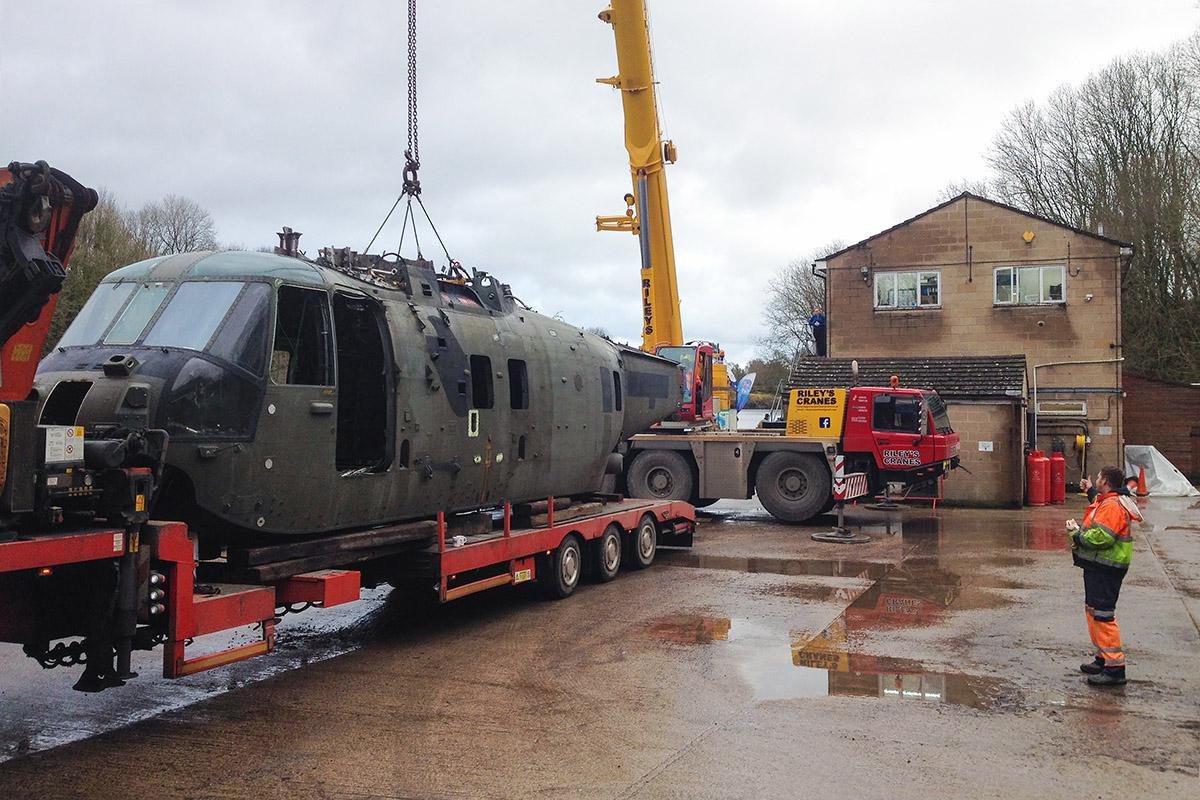
Arriving on site on a cold morning back in January 2018, this latest addition to Vobster's collection of diving curio came about in a most unexpected way. As site manager Tim Clements points out, it's a story all about the diving network. "A Vobster diver who works for Vector Aerospace near Gosport approached us regarding some helicopter fuselages that they had for disposal. I was immediately excited by the idea. Following a more in-depth chat at the Birmingham Dive Show, we went away scratching heads to work out the feasibility of taking ownership of one of the fuselages and the responsibility for its removal from Gosport before the deadline."

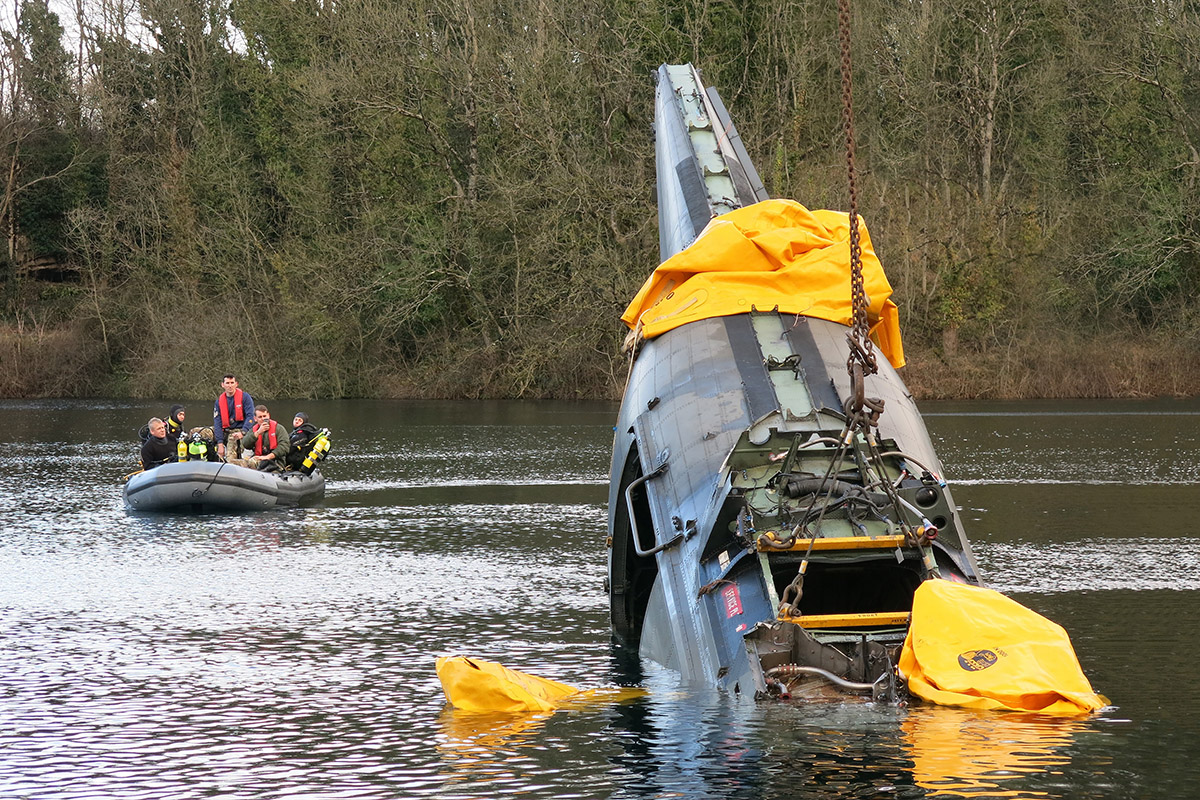
Getting a Sea King helicopter from Gosport to Vobster may sound straightforward but there's a lot more to it than meets the eye. "Aircraft are great because they are light - but dive attractions are good if they are also big and it's the big bit that causes problems for transport. Over a certain size and the entire route has to be assessed for bridges, overhead wires and trees by qualified hauliers – and that's just to get the load to our front door. Once on site, the lifting and diving operations needed to be safe and coordinated – that's a job for experts and luckily we have a great relationship with the British Army's 22 and 26 Royal Engineer dive teams who stepped in to help."
"With the engines and gearboxes gone, the residual contaminants were gone too – our Sea King arrived very clean."
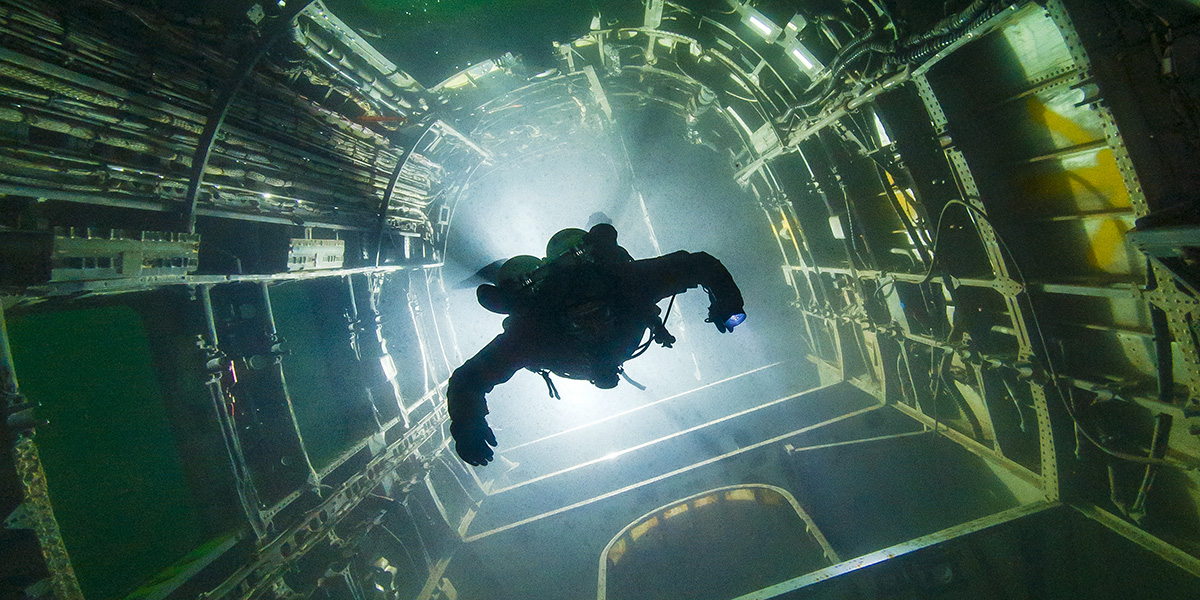
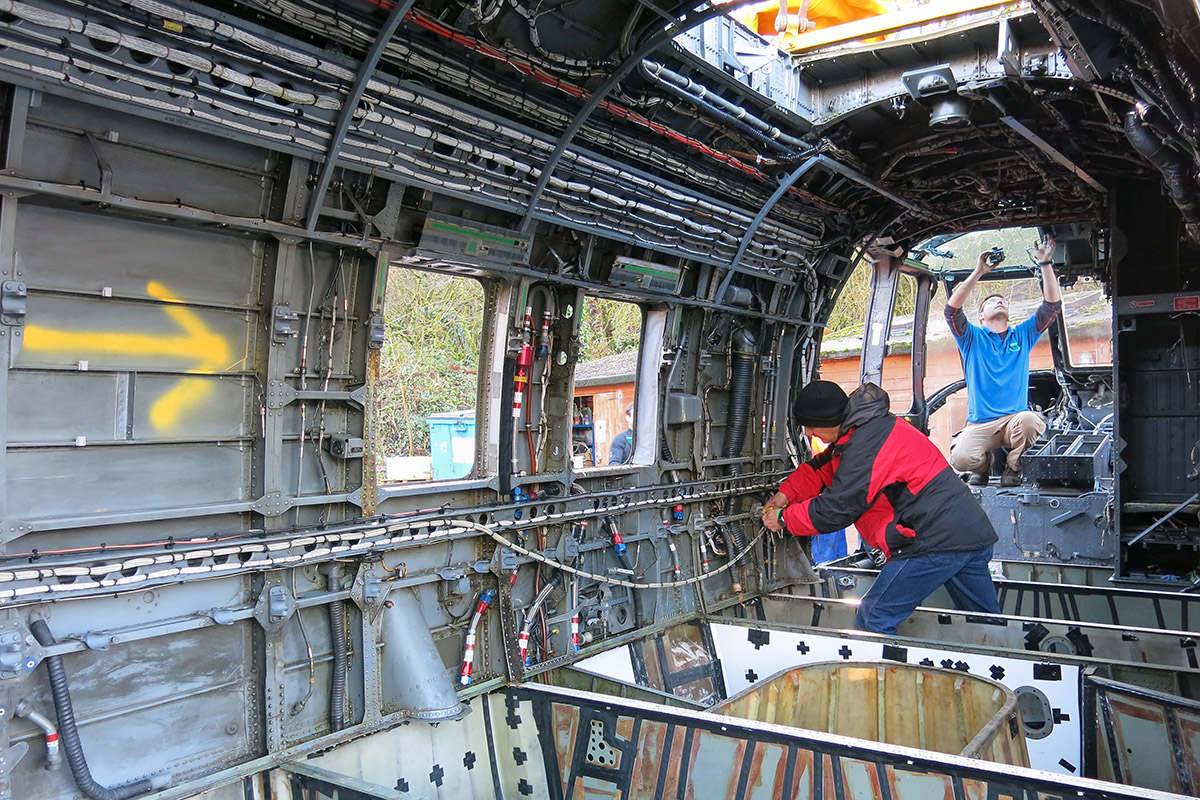
By their very nature, helicopter fuselages are a mass of internal fittings, cabling and, of course, residual contaminants that need to be dealt with before any new dive attraction hits the water. Fortunately for Vobster, Vector Aerospace had done most of the work for them. "The fuselage arrived as a carcass pre-stripped of instrumentation and fittings. With the engines and gearboxes gone, the residual contaminants were gone too – our Sea King arrived very clean. All we had to do was ensure that there were no snag hazards that could trap divers. Having dealt with all the hanging and protruding stuff, the yellow paint came out for some internal 'exit arrows' to aid navigation in bad viz. The exits were large and clear so we were good to go – the Royal Engineers then took over and dropped it into the lake precisely where we wanted it."

Duck Diving the Sea King
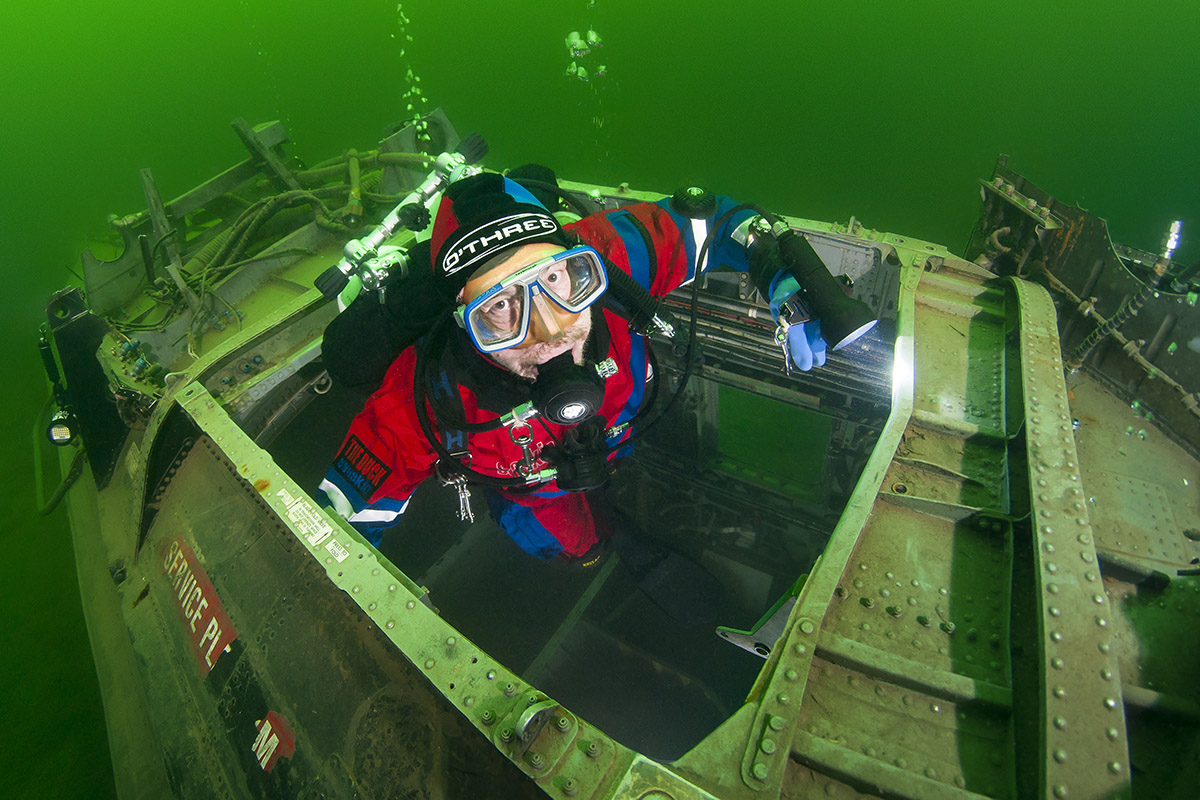
With the Sea King sat safely upright on the lake bed, there was no shortage of divers wanting to be among the very first to visit ZA299 in her new home. With long-time buddy Paul Duckworth along to provide the essential 'eye candy' for my photos, we grabbed our gear and headed to Vobster Quay to explore this new wreck for ourselves.

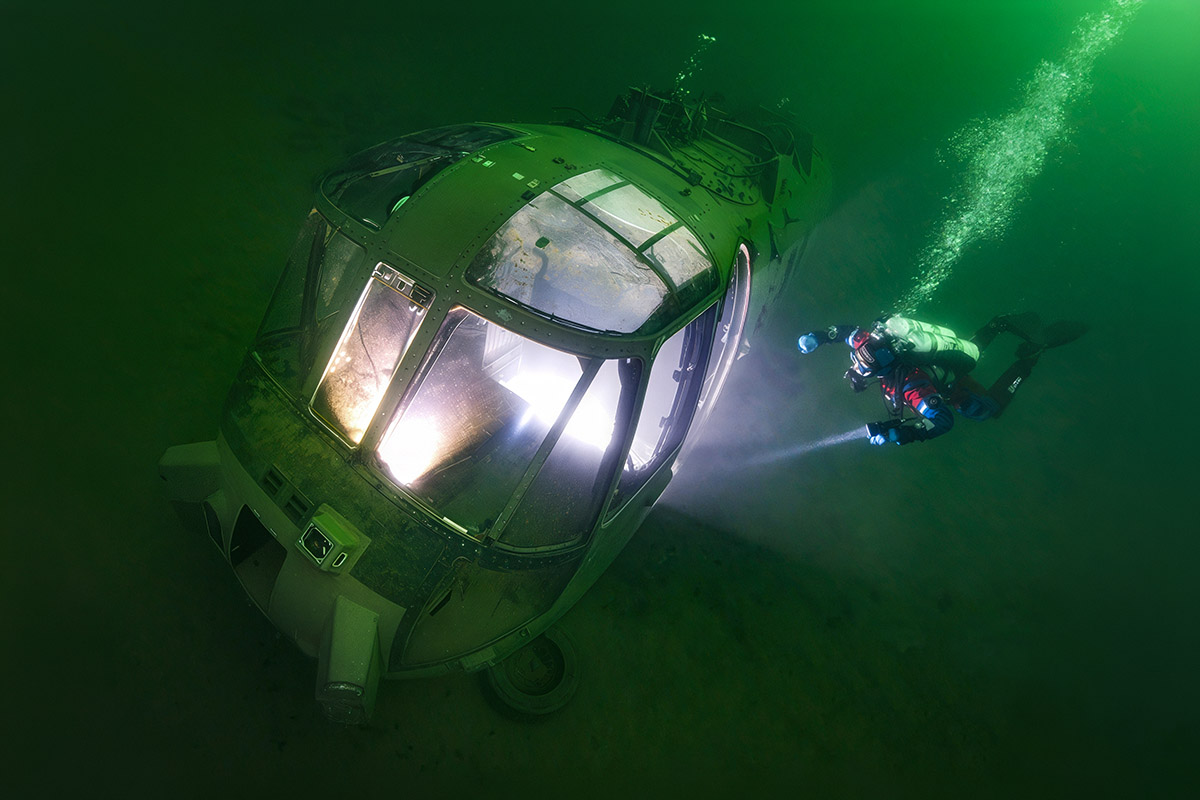
Finding Vobster's new dive attraction wasn't difficult at all. Dropping into the water at the slipway, we headed down the track towards the shallow entrance to the infamous Vobster tunnel, slipped over the top of it and then descended down a silty slope on the opposite side towards a gloomy shadow in the distance. Within a matter of minutes of entering the water, we'd arrived – ZA299 appeared side on right in front of us.
"After a quick circuit taking in her exterior, it's hard not to be tempted to venture inside"
Sat at a depth of around 24 metres, it now lives within close proximity of a number of other popular attractions including the old quarry Crushing Works and the deeper of Vobster's two Wheelhouses. "We put a lot of thought into how divers like to 'bimble' around Vobster" muses Tim Clements. "The opportunity to put a big object right in the middle of the lake opens up several interesting route combinations but keeps it both accessible and convenient for training courses."

Venturing inside...
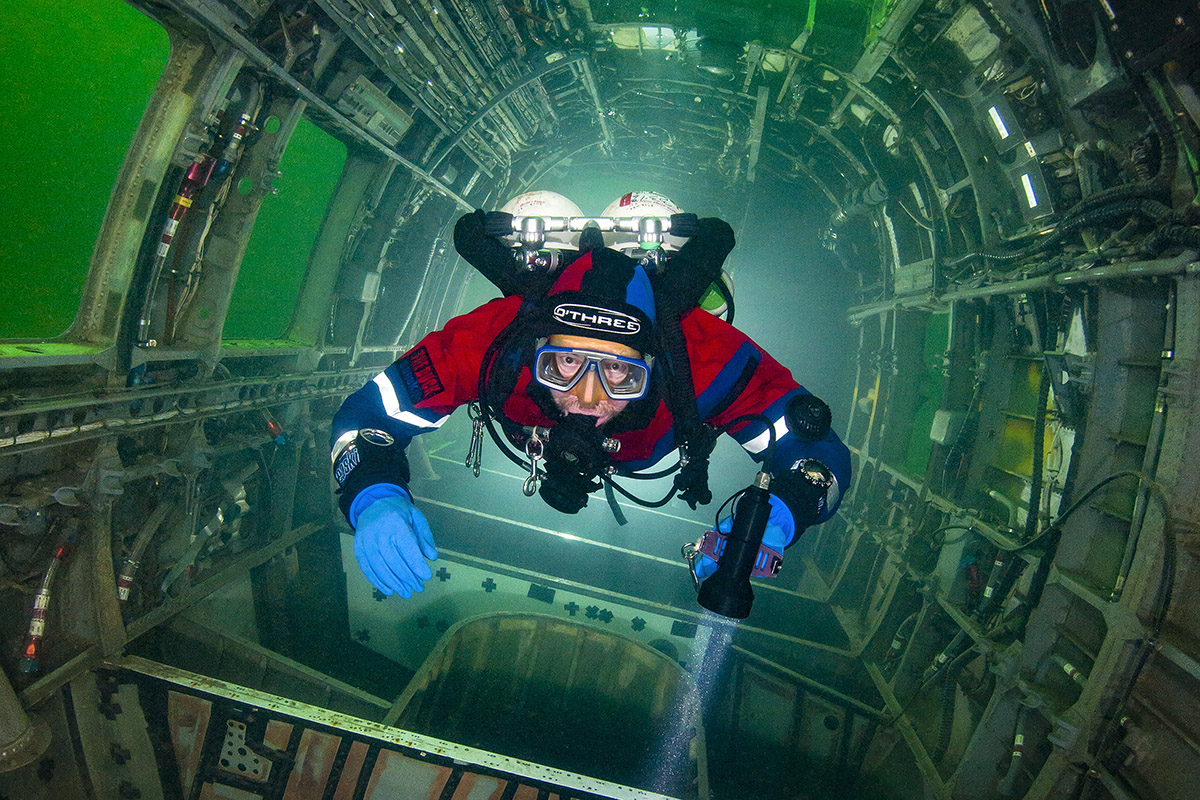
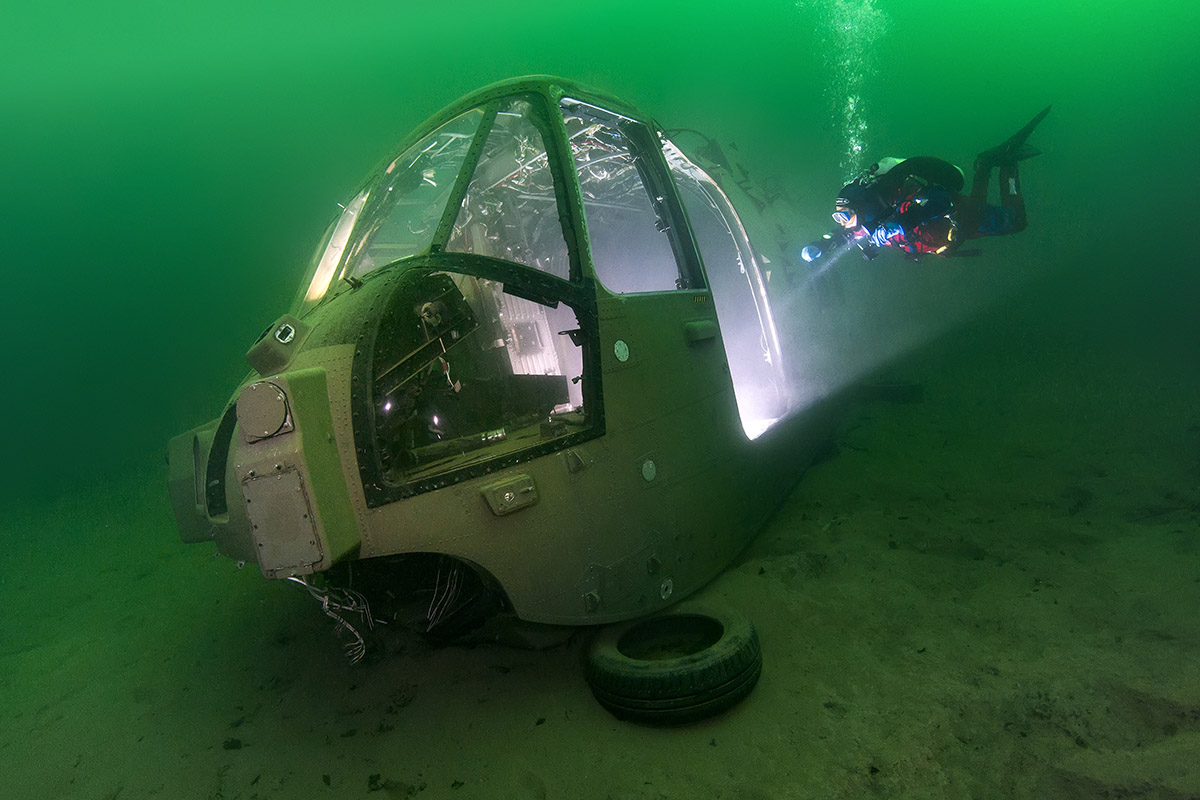
Measuring a good 20 metres in length, ZA299 is quite an impressive sight. After a quick circuit taking in her exterior, it's hard not to be tempted to venture inside – with wide open doors on either side, exploration of the inner area is suitable for most divers comfortable within an overhead environment. Try to avoid kicking up the bottom on your way in, though - the fine silt in this part of the lake can reduce visibility pretty quickly. Once inside, there's plenty to look at despite the skeletal appearance.

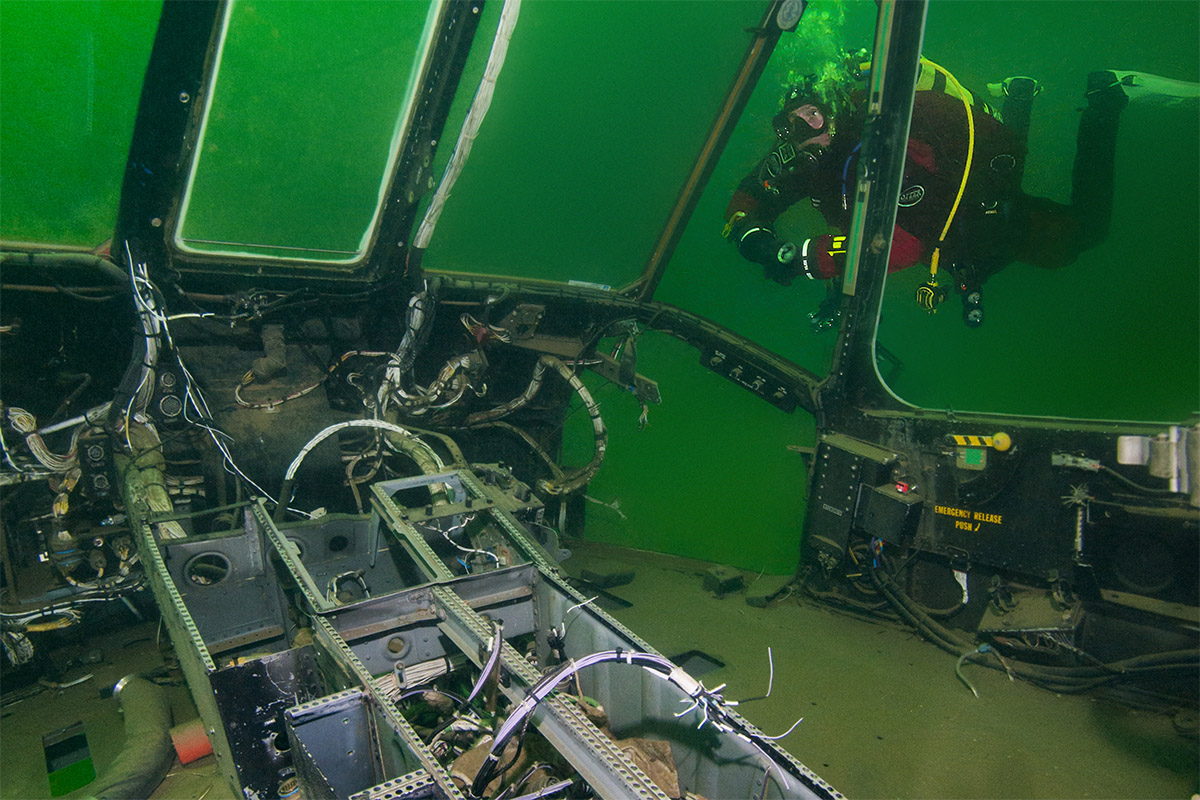
The cockpit still features a central control panel and more than a few mysterious handles and pulleys just crying out to be twiddled. With two open doors, a big square hole in the roof and a series of small windows strategically placed along her side – not to mention a very open cockpit – there's plenty of light to aid your vision. That said, a good torch will enhance your exploration of this distinguished addition to Vobster's lake-bed residents.
All content © Jason Brown 2010-2026
No content may be reproduced without express written permission.